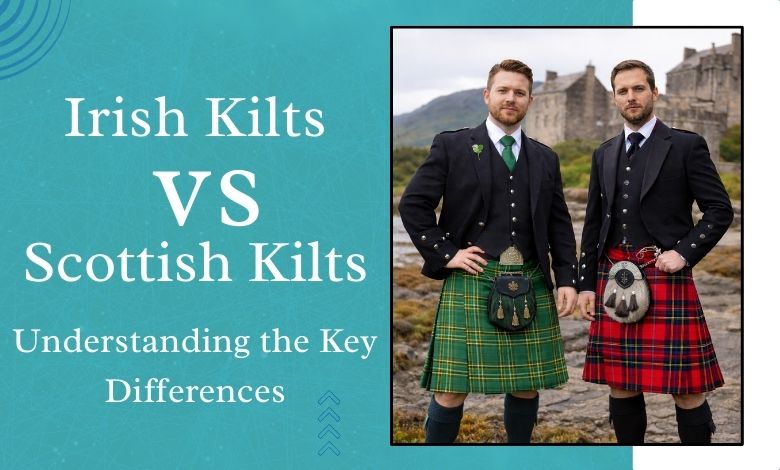
Those who are not fully aware of Scottish outfits don’t know that kilts have different variations. Other than different variants of men’s kilts, they also belong to several countries, with Scotland and Ireland being prominent ones. It is commonly thought that both countries wear the same kilts, but the reality can blow minds, as the kilts not only differ in their identity but also aesthetically. So, without further delay, let’s begin our discussion.
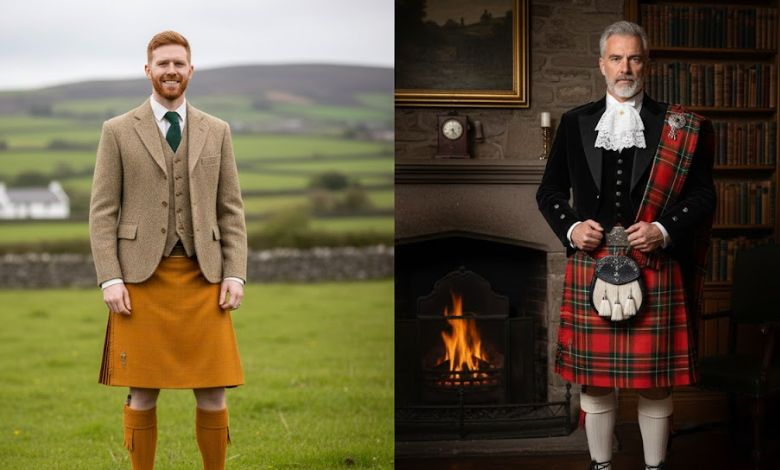
When we closely observe the differences between Scottish and Irish kilts, we spot natives wearing them in different eras. Likewise, their patterns differ from each other, and even garments in both countries define their identities in separate ways.
Historical Background of Irish and Scottish Kilts
Origins of the Scottish Kilt: This point may be invalid for many, but it is a truth and a factual point that their histories are also different. According to information existing on several platforms, Scottish kilts were first worn in the 16th century as great kilts that were a longer piece of fabric wrapped around the body.
Origins of the Irish Kilt: On the other hand, Irish kilts are pretty recent comparatively, and people there adopted them as national dresses a century ago. They started wearing kilts as a Celtic symbol that has a non-English identity. Some Irish figures, such as Sir Shane Leslie and William Gibson, began wearing kilts around the turn of the 20th century.
Fabric and Tartan Differences
Scottish Clan Tartans: The next aspect that visually shows the difference between Irish and Scottish kilts is their patterns. Scottish kilts often have bright shades with simple patterns. Scottish tartan kilts often talk about their clans and all the colours; they explain about the nature of the tribe’s people.
Irish County and National Tartans: Irish patterns that are mild in tones but more complex than Scottish kilts and do not belong to any tribe but Irish regions or counties. The most traditional and popular colour used in Irish kilts is saffron; people even wear saffron kilts at formal events to appreciate their heritage.
Design and Construction
Scottish Kilts Design: Another important side of Irish kilts vs. Scottish kilts that we must cover are the differences in their designs. The sizing is the same for both, but the design is dissimilar, as Scottish kits are often back-pleated. Moreover, they are made with pure wool.
Design of Irish Kilts: Irish kilts, on the other hand, have pleats on the sides, offering them distinctive looks compared to Scottish kilts. Regarding the materials, they are also made with wool, as kilts in both countries belong to the Highlands and are influenced by Celtic culture.
Accessories Worn with Irish and Scottish Kilts
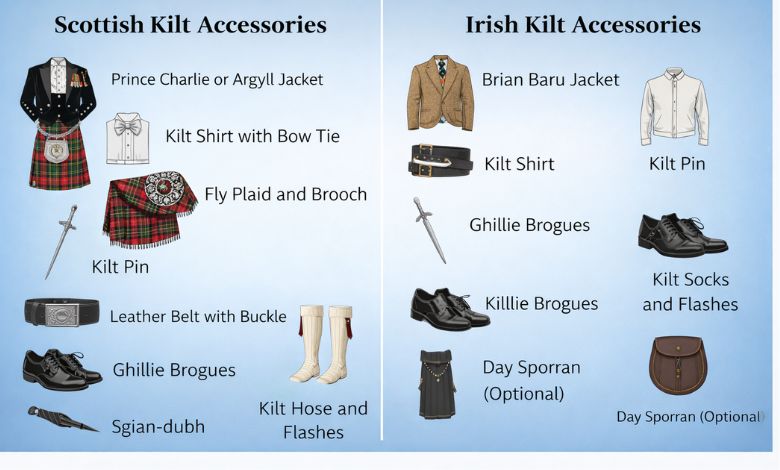
Scottish Kilt Accessories: Many people assume that the same accessories are attached with kilts in both countries to complete dresses, but it is a misconception. The Scottish outfits need more accessories, and they are given below:
| Prince Charlie or Argyll Jacket | Kilt shirt with Bow Tie | Fly plaid and Brooch |
| Kilt Pin | Leather belt with Buckle | Ghillie Brogues |
| Sporrans | Kilt Hose and Flashes | Sgian-dubh (Optional) |
Irish Kilt Accessories: Let’s talk about the accessories to pair with Irish kilts. These attributes are lesser than Scottish while a few things are different. Here is the list of Irish kilt accessories.
| Brian Baru Jacket | Kilt Shirt |
| Kilt Pin | Ghillie Brogues |
| Kilt Socks and Flashes | Day Sporran (Optional) |
Occasions and Cultural Use
When Scottish Kilts Are Worn: Are Scottish and Irish kilts worn at every event? Do they both serve as everyday wear? No. Scottish kilts are modernised with time and suit all environments, whether it is a formal or casual event. In fact, modern kilts are also worn as everyday suits.
When Irish Kilts Are Worn: The story of Irish kilts is a bit different, as people in Ireland wear kilts only in formal settings such as National Ireland Day and Saint Patrick’s Day. It can be a reason for them to wear classical Irish kilts only rather than modern ones.
Irish Kilts vs Scottish Kilts: Side-by-Side Comparison
| Features | Scottish Kilts | Irish Kilts |
| Historical Origin | Originated in the 16th century as the Great Kilt, worn in the Scottish Highlands | Adopted in the early 20th century as a Celtic symbol of Irish national identity |
| Tartan and Patterns | Clan-based tartans with bold colors and symbolic meanings | County or national tartans with softer tones; saffron is traditional |
| Cultural Identity | Represents specific clans and family heritage | Represents Irish regions and non-English Celtic identity |
| Design and Pleats | Back-pleated construction | Side-pleated construction |
| Fabric Material | Traditionally made from heavyweight wool | Typically made from wool as well |
| Occasions to Wear | Worn at both formal and casual events, including modern everyday use | Mostly worn at formal and national events like St. Patrick’s Day |
Misconceptions About Scottish and Irish Kilts
- Many people believe Irish and Scottish kilts are identical, but they differ in origin, tartans, pleating styles, and cultural symbolism.
- While Scotland popularised kilts globally, Ireland also has its own kilt tradition tied to Celtic revival and national identity.
- Scottish tartans are clan-based, but Irish tartans usually represent counties or national heritage, not families.
- Scottish kilts date back to the 16th century, whereas Irish kilts became common in the early 20th century.
- Scottish kilts require more formal accessories, while Irish kilts use fewer and different items, reflecting distinct dress traditions.
Where to Buy Irish and Scottish Kilts
A few kilt-sellers are there who sell both Irish and Scottish kilts, and careful selection of the stores is important for a true Highlander look. So, where should you buy from? You must connect with a store that not only sells high-quality kilts but also customises them for a perfect fit. Utility Kilt UK is one of the finest options that also believes in affordability and staying connected with customers. So, visit us right now and fulfil your kilt requirements.
FAQs About Kilts in Ireland and Scotland