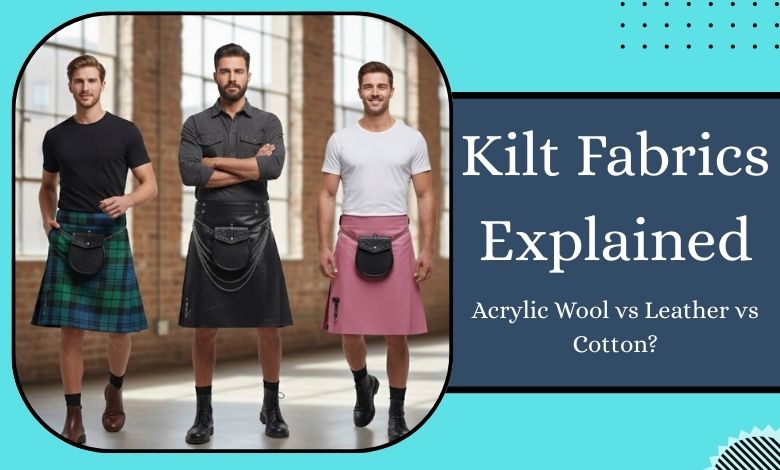
Kilts have been worn for centuries and have adopted several changes. These changes are not in the form of shapes only, but utility features are also added along with changes in the fabric. Men’s kilts today are made with various natural and synthetic fabrics, while the most used materials are acrylic wool, leather, and cotton. All feature distinctive traits and suit different settings from formal to casual. This guide will highlight all of these mentioned ones. So, let’s begin our article here!
Overview of Common Kilt Fabrics
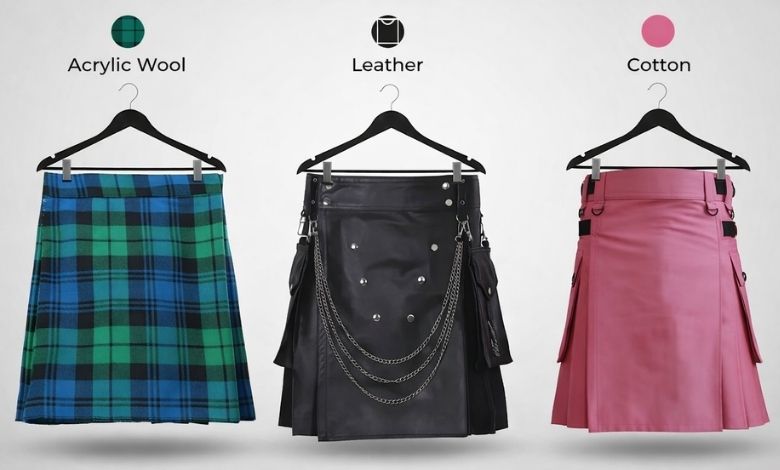
The selection of kilt fabrics while choosing a garment is becoming challenging now, as numerous materials are used today. No matter what kind of fabric you choose, comfort and dealing with different weather are the priorities. Our core attention today, even if acrylic wool, leather, or cotton is used in different kinds of men’s kilts, fulfills the comfort requirements authentically, while fitting different weathers can be a concern. Let us start our discussion with acrylic wool.
Acrylic Wool Kilts
Acrylic wool is the most used fabric to make tartan kilts today, instead of pure wool. It is a synthetic fabric that mimics pure wool perfectly but has a little different characteristics comparatively. The best way to find out the traits of a fabric is to explore their advantages and disadvantages, and we’ll adopt this approach to find out their dissimilarities.
Benefits of Wool Kilts
- Acrylic wool is cheaper than pure wool and is pretty affordable to students and performers.
- This particular copy of wool is easy to maintain compared to pure wool.
- Those who are durability conscious find it more rugged, and acrylic wool has the ability of shape retention.
- It fulfils the comfort requirements effectively compared to wool because of being lightweight.
- Most importantly, it holds the dyes for extended durations.
Drawbacks of Acrylic Wool Kilts
- Poor breathability can be a major issue for many people while wearing acrylic wool kilts.
- Being a synthetic material, acrylic wool is not biodegradable and promotes sustainability.
- Acrylic wool kilts do not offer the feel of authenticity.
- Lacking the breathability may result in catching body odours for longer durations and may need more care.
Best Use Cases
Pure wool or tartan kilts can be costly for many people; that’s why people are seen switching to acrylic. Surprisingly, it is also used where pure wool is used, and many people cannot distinguish between pure and acrylic wool. So, this fabric is an ideal option for all formal events, including weddings, formal dinners, Highland Games, and more.
Leather Kilts
Let’s talk about leather now, which is one of the most comfortable fabrics and is used in making leather kilts. The leather provides them a bulkier look, which is another reason for people to opt for it. Furthermore, they come with utility attributes enhancing their aesthetics and making them utility-friendly as well.
Advantages of Leather
- Leather kilts are considered the most modern, bold, and stylish kilts.
- The comfort and durability they provide are matchless, making them the most long-lasting form of kilts.
- It has a rich texture which helps them to become the ideal pair of tartan accessories.
- Existing in black and brown once, but now they are available in different shades and ideal options for fashion-orientated people.
Disadvantages of Leather Kilts
- Leather kilts are more expensive than other kilts, whether they are modern or the traditional ones.
- They are prone to damage and can get cracks after a bit of carelessness, which means they have high care requirements.
- Different types of leather are used in making kilts, and spotting the ideal one can be challenging for those who are new to kilts.
- The maintenance cost can be higher as well.
Best Use Cases
Leather kilts suit casual settings because they are a modern twist on the traditional kilts. However, people wear them at casual and some semi-formal events, and some of these events are listed below:
| Cultural festivals | Nightclub celebrations |
| Daytime weddings | Modern dancing events |
| Casual outings | Nightouts |
Cotton Kilts
This is the time to talk about the most used material in making garments (not only kilts), and it is none other than cotton. The most breathable fabric and an ideal choice to wear in summer, cotton is used in the formation of utility kilts and more modern kilts. Most of these variations are utility-friendly and come with practical features because of cotton’s durability, breathability, and comfort.
Advantages of Cotton Kilts
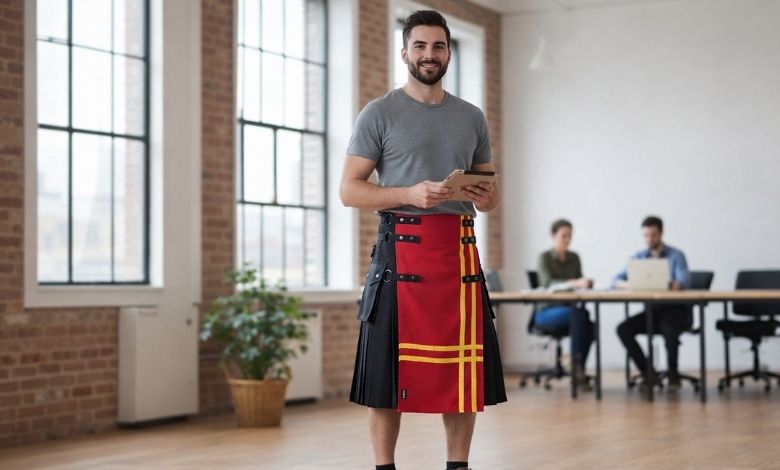
- Original cotton kilts propose a high degree of comfort and breathability that prevents sweat buildup.
- The fabric is lightweight, and it helps in the easiest movement, thanks to the pleating system.
- Many cotton kilts are machine washable, which means they are easy to care for and require low maintenance.
- Being a natural material, it treats the skin and does not cause irritation even after long wear.
Disadvantages of Cotton Kilts
- Cotton kilts are prone to wrinkles and can get creased over regular use.
- Shrinkage is another issue, which means care instructions need to be followed strictly.
- Cotton kilts are available in solid shades, indicating them to be simpler than other variations.
- Washing in hot water or wearing it continuously in sunlight can fade the colour.
Best Use Cases
Cotton-made kilts, whether they are utility or tactical kilts, are suitable for modern use and cannot be worn at formal events. Moreover, their practical features define their suitability as workwear. So, they are ideal options for casual wear, workwear, and sportswear.
<Comparison Table: Acrylic Wool vs Leather vs Cotton
| Features | Acrylic Wool Kilts | Leather Kilts | Cotton Kilts |
| Cost and affordability | Affordable and budget-friendly compared to pure wool | Expensive due to material and maintenance | Generally affordable and cost-effective |
| Comfort and breathability | Lightweight but poor breathability | Comfortable but heavier and less breathable | Highly breathable and comfortable, ideal for warm weather |
| Maintenance and durability | Durable, good shape retention, easy maintenance | Extremely durable but requires high care and maintenance | Durable but prone to wrinkles and shrinkage |
| Appearance and style | Closely mimics traditional wool tartan look | Modern, bold, stylish, and bulky appearance | Modern, mostly solid colors |
| Best use case | Formal events, weddings, Highland Games | Casual to semi-formal events, festivals, nightlife | Casual wear, workwear, sportswear |
Choosing the Right Kilt Fabric for You
Now that you are familiar with the features of different kilt fabrics, including acrylic wool, cotton, and leather, the next thing is to choose the right one. Wearing the wrong material at any event is not a good idea, so follow the below-given instructions.
- First of all, the event’s formality should be your priority because wearing a cotton kilt formally is not recommended.
- Likewise, you should consider the weather or climate because lightweight cotton kilts are only worn on warm days.
- Set a budget and stick to it while buying any of these kilts.
- Your personal style also matters, but in casual settings, because wool kilts are ideal to wear formally.
Buy Kilts Made with Different Fabrics at Utility Kilt UK
No matter which kilt you need from cotton, wool, or leather, the quality should be premium. There are a few stores that do not deal with lower quality, and a well-known name among them is Utility Kilt UK. Being one of the best kilt makers, we deliver kilts to your doorstep at affordable prices. Similarly, we are available 24/7 to respond to our customers in case of any query.
FAQs About Different Kilt Fabrics