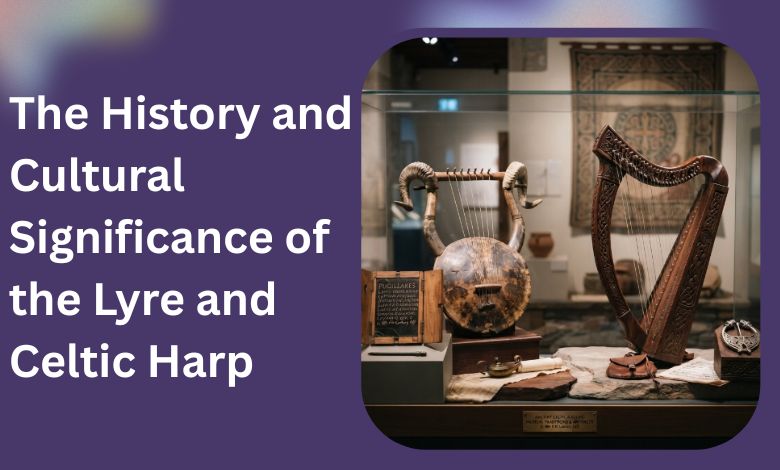
Both are the old string instruments, the lyre and Celtic harp but they are from different music styles. The lyre was found in a number of ancient Mediterranean and Near Eastern societies and the Celtic harp was increasingly associated with Gaelic Ireland and Scotland. Their past demonstrates the potential of music tools to be not used just for entertainment, but also as means of poetry, recollection, ceremony, and personal identity.
What Is a Lyre?
Origins of the Lyre
A string instrument of ancient origin having two vertical arms and a crossbar. The earliest known lyres are from Mesopotamia, one example of which was found in a royal Ur tomb dated to about 2500 B.C. The lyre was also significant in ancient Greece, where it was linked to education and the arts, particularly poetry.
How the Lyre Was Used in Ancient Cultures
The Ancient Greeks played lyres for educational purposes, ceremonies, community events and to entertain with poetry. These types of frame drums were found in other areas, but with different shapes and playing techniques. It was normally played by fiddling the strings with fingers or a plectrum.
The Lyre’s Role in Storytelling and Music
Associations with songs, through the lyre, were already strong. Greeks used string accompaniment to sing, present their history, poems and songs. This relationship between music and the spoken tradition is significant because in many cases knowledge was not transmitted through literature, but by oral means, prior to the wide-spread use of literature.
What Is a Celtic Harp?
Origins of the Celtic Harp
It has never been used to call direct descendants of the Greek lyre and now forms a unique Gaelic instrument rather than being a direct descendent of the ancient Greek lyre. The harp was a triangular instrument, with ingredients and a curved neck, and strings connecting the neck to the soundbox, which then dates from early Ireland and Scotland. Harping dates back in Gaelic society to the early second millennium CE as evidenced in the Medieval period.
The Irish and Scottish Harp Traditions
The harp was an integral and intimate part of the life of professional musicians and poets employed by important families and courts in Ireland. There was a tradition of harping in Scotland, the clàrsach. In many instruments from history, metal strings were used by both traditions where as a result in history, the sound produced was bright and resonant.
How the Celtic Harp Differs From Other Harps
The harp as it is known today is larger and superficially more similar to the Gaelic harp which was actually smaller in size and made in a different way. It had the characteristics of such metal strings, a small structure, and its playing method, so that its sound was different. Modern Celtic harps could be nylon strung or other strings and are intended for modern musicians.
The History of the Celtic Harp in Ireland and Scotland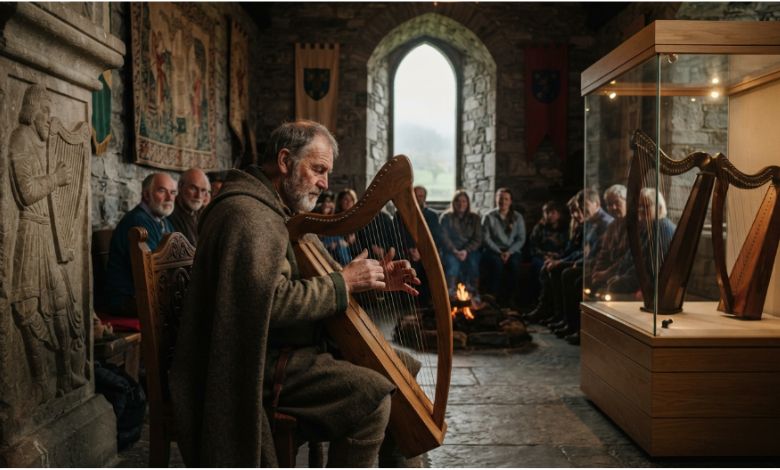
The Harp as a Symbol of Irish Heritage
The harp came to symbolise strength for Ireland. It is the Irish state symbol and it is also featured in Ireland’s heraldry. The famous Brian Boru harp in Trinity College Dublin is historically linked with the king of the medieval period, Brian Boru although this is not a certain attribution.
The Harp in Scottish Culture
The clàrsach was used in Scotland and forms part of Gaelic musical culture used by professional harpers. In Gaelic society the harper was regarded with great respect and reverence as a learned man or woman within the culture. There is evidence of the harp’s importance in medieval Scotland from surviving instruments and carvings.
Medieval and Gaelic Connections
In the Middle Ages, musical men, women, poets and learned men and women were encouraged in kind and love, in the Gaelic courts. Harpers entertained the important families and safeguarded culture through their music. On-going emigration and the ‘modernisation’ of the Gaelic community over time, combined with alteration of musical preferences, limited the prominence of the harper role and profession, but with cultural renaissance the harper survived.
Lyre vs Celtic Harp: What Is the Difference?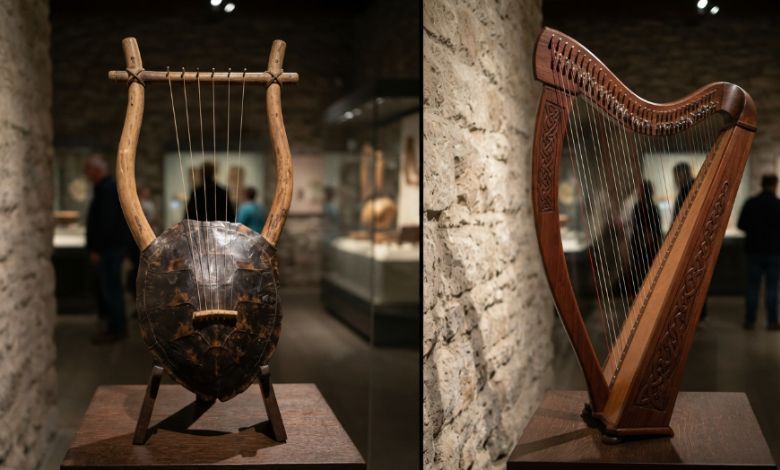
- The construction and historical traditions are the only real distinctions.
- A lyre is a stringed instrument that has two arms attached by a crossbar, on which the strings are strung.
- The Celtic harp is a stringed instrument featuring a triangular body, a curved neck and strings that go diagonally.
- The lyre is particularly associated with ancient music in the Mediterranean and the harp has a special connection with Gaelic Ireland/Scotland.
Cultural and Symbolic Significance of the Celtic Harp
Harp as a Symbol of Irish Identity
The harp would go on becoming a symbol of Ireland. It can be found on Irish passports, the Irish official seals and on official Irish documents from the government. It also had a long political history, with the Irish movements taking up the harp symbolising Ireland.
Music, Poetry, and Gaelic Tradition
The harp was intricately linked with Gaelic poetry and learning. Praise poetry, genealogy and ceremonial occasions were accompanied by professional harpers. Music, as a consequence, served to maintain social memory and entertainment.
The Harp in Modern Celtic Culture
Celtic harps are today heard in Irish and Scottish traditional music, concerts and festivals, schools and cultural programmes. Today’s players have the ability to appreciate past playing styles while creating contemporary and different musical compositions; the instrument has an ability to be embraced by tradition and by new musical forms.
Why the Lyre and Celtic Harp Still Matter Today
There is a long history of association between song and oral artistry and the lyre, along with musical skill and oral artistry of Gaelic Ireland and Scotland, that goes with the harp, too. As they are still exploited today, they bear witness to the fact that traditional instruments are capable of life in the modern era and still have valuable historical significance.